
 Streamline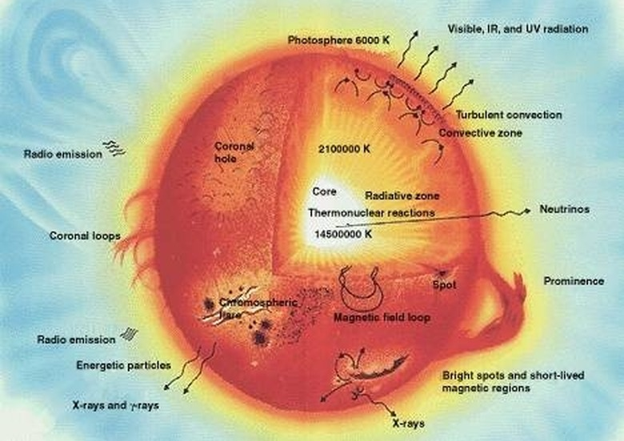
The Sun is the primary source of energy for Earth, providing the light and heat that make life possible. Every second, it releases an enormous amount of energy that travels through space and reaches our planet in about eight minutes. But where does this energy come from? The answer lies deep within the Sun’s core, where an extraordinary physical process continuously converts matter into energy.
The Sun Nuclear Fusion Reaction is the mechanism responsible for producing the Sun’s immense energy output. By understanding the Nuclear Fusion Process in The Sun, students can better appreciate how stars generate energy and why nuclear fusion is one of the most important processes in the universe.
What Is Nuclear Fusion?
Nuclear fusion is a process in which two or more light atomic nuclei combine to form a heavier nucleus. During this reaction, a small amount of mass is converted into energy according to Albert Einstein’s famous equation:
E = mc²
This equation states that mass and energy are interchangeable. Even a tiny amount of mass can produce an enormous amount of energy because it is multiplied by the square of the speed of light.
Unlike nuclear fission, which splits heavy atomic nuclei, nuclear fusion joins lighter nuclei together. Fusion is the primary source of energy for stars, including the Sun.
Where Does Fusion Take Place in the Sun?
The Sun Nuclear Fusion Reaction occurs in the Sun’s core, which extends to about 20–25% of the Sun’s radius. Conditions inside the core are extremely intense:
-
Temperature: approximately 15 million Kelvin
-
Pressure: more than 250 billion times Earth’s atmospheric pressure
-
Density: about 150 g/cm³
These extreme conditions allow positively charged hydrogen nuclei to overcome their natural electrostatic repulsion and move close enough for the strong nuclear force to bind them together.
Without these immense temperatures and pressures, nuclear fusion would not occur.
The Nuclear Fusion Process in The Sun
The primary Nuclear Fusion Process in The Sun is called the proton–proton (pp) chain reaction. This series of nuclear reactions converts hydrogen into helium while releasing large amounts of energy.
The simplified process involves three main steps:
Step 1: Formation of Deuterium
Two hydrogen nuclei (protons) collide under extremely high temperature and pressure. One proton changes into a neutron, forming a deuterium nucleus while releasing a positron and a neutrino.
Step 2: Formation of Helium-3
The deuterium nucleus combines with another proton to produce helium-3. During this reaction, a gamma-ray photon is emitted, carrying away a significant amount of energy.
Step 3: Formation of Helium-4
Two helium-3 nuclei eventually collide and fuse to form one helium-4 nucleus. This reaction also releases two protons, which can participate in additional fusion reactions.
Overall, four hydrogen nuclei are converted into one helium nucleus, with a small amount of mass transformed into energy.
How Fusion Produces the Sun’s Energy
The energy released during fusion first appears as high-energy gamma rays. As this energy moves outward through the Sun’s interior, it is repeatedly absorbed and re-emitted by particles. During this long journey, the radiation gradually loses energy and changes into visible light, infrared radiation, and other forms of electromagnetic energy.
Once the energy reaches the Sun’s surface, it is emitted into space. A small fraction eventually reaches Earth, providing sunlight that supports weather systems, plant growth through photosynthesis, and nearly all forms of life.
Why Fusion Can Continue for Billions of Years
The Sun contains an enormous supply of hydrogen fuel. Scientists estimate that it has been generating energy through nuclear fusion for about 4.6 billion years and will continue doing so for another 5 billion years before exhausting most of the hydrogen in its core.
As long as sufficient hydrogen remains and the core maintains the required temperature and pressure, the fusion process will continue producing a steady supply of energy.
This remarkable stability explains why the Sun has remained a reliable energy source throughout Earth’s history.
Why Studying Solar Fusion Is Important
Understanding the Sun Nuclear Fusion Reaction helps scientists explain how stars produce energy, evolve, and create many of the chemical elements found throughout the universe.
The Nuclear Fusion Process in The Sun also inspires research into controlled nuclear fusion on Earth. Scientists are working to develop fusion reactors that could one day provide a clean and nearly limitless source of energy using the same basic principles that power the Sun.
Although practical fusion power remains under development, studying the Sun continues to improve our understanding of both astrophysics and future energy technologies.
Conclusion
The Sun Nuclear Fusion Reaction is the fundamental process that powers our nearest star. Through the Nuclear Fusion Process in The Sun, hydrogen nuclei combine to form helium, releasing enormous amounts of energy that sustain the Sun’s brightness and provide the heat and light essential for life on Earth.
By understanding how nuclear fusion works, students gain valuable insight into stellar physics, energy production, and the remarkable forces that shape our universe. The Sun serves as a natural example of the power of nuclear fusion and remains one of the most important objects of study in modern physics.
